
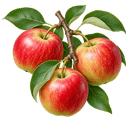
Apple
Malus domestica
The cultivated apple is a deciduous fruit tree of the rose family whose size is determined mainly by the rootstock, ranging from about 2 m spindle trees to standard trees of 6–10 m. Most cultivars are not self-fertile and need a compatible pollinator flowering at the same time.
Overview
Seasons
Planting time for bare-root trees. Container trees can be planted whenever the soil is workable.
Grafted forms
| Form | Height | Crown diameter |
|---|---|---|
| Spindle bush | 1.8–2.4 m | 1.8–2.7 m |
| Bush tree | 2.4–4 m | 3.6–4 m |
| Half-standard | 4–6 m | 4–6 m |
| Standard | 6–10 m | 6–9 m |
Typical sizes; the rootstock, variety and pruning decide the actual size.
Companion Planting
Good Companions
- Crabapple
Most apple cultivars need cross-pollination by another Malus flowering at the same time; selected crabapples are proven pollinizers giving high fruit set (note: crabapple is also a fire blight host).
 Crabapple
Bad Companions
None
Shared disease: fire blight
Other hosts in the database: Pear, Quince, Rowan, Serviceberry, Crabapple. An infected tree can pass the disease on to them.
Only relations with a documented cause are listed.
Toxicity
Fruit flesh is edible. Stems, leaves and seeds contain cyanogenic glycosides (seeds: amygdalin, about 1–4 mg/g); ASPCA lists apple as toxic to dogs, cats and horses, especially wilting leaves.
Planting Tips
Care Tip: Small tree forms on weak rootstocks need annual pruning and a permanent stake; choose scab-resistant cultivars for low-input gardens and protect roots from voles with wire baskets.
Sources
- Rootstocks for fruit — Royal Horticultural Society (RHS)
- Gehölzschnittseminar 'Alte Obstbäume in neuem Glanz' – Baumformen und Unterlagen, Maße und Eigenschaften (26 Feb 2026) — Lorenz von Ehren Baumschule / von Ehren Akademie
- Merkblatt 3101: Veredlungsunterlagen von Obstgehölzen für den Hausgarten — Bayerische Gartenakademie, LWG Veitshöchheim
- Merkblatt 3162: Die Favoriten der Apfelsorten für den Haus- und Kleingarten — Bayerische Gartenakademie, LWG Veitshöchheim
- How to grow apples — Royal Horticultural Society (RHS)
- Malus domestica (Apple) — NC State Extension Gardener Plant Toolbox
- TreeEbb: Malus domestica — Boomkwekerij Ebben (tree nursery, NL)
- Pflanzen und ihre Wurzelsysteme (G. R. Richter, 20.12.2024) — Bundesverband Deutscher Gartenfreunde e.V. / Gartenfreund
- Apple (Malus sylvestrus) – Toxic and Non-Toxic Plant List — ASPCA Animal Poison Control
- Bolarinwa I.F., Orfila C., Morgan M.R.A. (2015): Determination of amygdalin in apple seeds, fresh apples and processed apple juices. Food Chemistry 170: 437–442 — White Rose Research Online (University of Leeds repository)
- EPPO Datasheet: Erwinia amylovora (last updated 2020-04-22) — European and Mediterranean Plant Protection Organization (EPPO)
- Fireblight — Royal Horticultural Society (RHS)
- Bessho H. et al. (2009): Selection of Crabapple Pollinizers for 'Fuji' and 'Tsugaru' Apple. J. Amer. Pomol. Soc. 63(1): 2–13 — American Pomological Society
- How to grow quinces — Royal Horticultural Society (RHS)
- Fire Blight – Fact Sheet 2.907 — Colorado State University Extension
- Pflanzengesundheitliches Datenblatt Erwinia amylovora (ERWIAM 3/2022) — Julius Kühn-Institut (JKI)
- Sorbus aucuparia (rowan) plant profile — Royal Horticultural Society (RHS)