
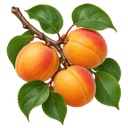
Apricot
Prunus armeniaca
Apricot (Prunus armeniaca) is a small, round-headed deciduous fruit tree that flowers white to pale pink very early in spring, before the leaves, and bears yellow-orange, velvety stone fruit in summer. In Central Europe it succeeds only on warm, sheltered sites because the early blossom is easily damaged by late frost.
Overview
Seasons
Planting time for bare-root trees. Container trees can be planted whenever the soil is workable.
Companion Planting
Good Companions
None
Bad Companions
- Tomato
Tomato is a host of Verticillium wilt; UC IPM advises against interplanting young apricot orchards with susceptible crops such as tomatoes.
 Tomato
Shared disease: sharka (plum pox)
Other hosts in the database: Plum, Peach. An infected tree can pass the disease on to them.
Only relations with a documented cause are listed.
Toxicity
Seed kernels, leaves and stems contain the cyanogenic glycoside amygdalin, which releases cyanide; kernels are more poisonous when crushed or chewed, while swallowing a couple of whole pits does not cause poisoning. The fruit flesh is edible.
Planting Tips
Care Tip: Apricots fruit mainly on one- to three-year-old wood, so renew fruiting wood regularly and prefer removing a few larger branches over many small cuts. Whitewash the trunk in winter against frost cracks and cover blossom with fleece on frosty nights.
Sources
- Prunus armeniaca (Apricot) — NC State Extension, Extension Gardener Plant Toolbox
- Prunus armeniaca (apricot) plant profile — Royal Horticultural Society (RHS)
- How to grow apricots — Royal Horticultural Society (RHS)
- Obstbäume richtig pflanzen — Bundesinformationszentrum Landwirtschaft (BZL), landwirtschaft.de
- Empfehlungen für optimale Pflanzabstände im Obstbau (J. Maurer) — Inforama, Fachstelle für Obst und Beeren, Kanton Bern
- Merkblatt 3160: Empfehlenswerte Steinobst-Sorten — Bayerische Landesanstalt für Weinbau und Gartenbau (LWG), Bayerische Gartenakademie
- Merkblatt 3160/b: Empfehlenswerte Steinobst-Sorten für den Haus- und Kleingarten (2017) — Bayerische Landesanstalt für Weinbau und Gartenbau (LWG), Bayerische Gartenakademie
- Degree days and chilling hours (table: chill hours to break dormancy, 45°F model) — University of Illinois Extension
- Apricot (Prunus armeniaca) — ASPCA Animal Poison Control
- Scharka (Plum pox virus) — AGES - Österreichische Agentur für Gesundheit und Ernährungssicherheit
- Apricot: Verticillium Wilt (Pest Management Guidelines) — UC Statewide IPM Program, University of California