
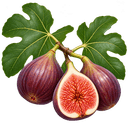
Fig
Ficus carica
The common fig is a deciduous large shrub or small, spreading tree from the Mediterranean region and western Asia with large lobed leaves and edible fruit. In Central Europe it is grown on warm, sheltered sites, often fan-trained against a wall, and most cultivars sold there are self-fertile.
Overview
Seasons
Planting time for bare-root trees. Container trees can be planted whenever the soil is workable.
Companion Planting
Good Companions
None
Bad Companions
None
Only relations with a documented cause are listed.
Toxicity
The milky latex (sap) of leaves and shoots contains furanocoumarins (psoralens) and the protease ficin; skin contact followed by sunlight can cause phytophotodermatitis, and ingestion causes gastrointestinal and dermal irritation in pets. The ripe fruit is edible.
Planting Tips
Care Tip: Protect young plants and fan-trained figs in winter (straw, fleece); shoots are damaged below about -10 °C but usually regrow. Wear gloves when pruning because the sap irritates skin.
Sources
- Ficus carica (F) – plant details — Royal Horticultural Society
- Ficus carica – TreeEbb datasheet — Boomkwekerij Ebben (tree nursery, NL)
- Ficus carica (Common Fig) — NC State Extension Gardener Plant Toolbox
- Der Anbau von Feigen (Merkblatt) — Landeshauptstadt Stuttgart, Beratungsstelle für Obstbau
- Lohnen sich Feigen im deutschen Freilandanbau? (report on LWG Veitshöchheim fig trial) — top agrar
- Growing Common Figs in the Low Desert (AZ1636) — University of Arizona Cooperative Extension
- How to grow figs — Royal Horticultural Society
- Ficus carica – Agroforestree Database — World Agroforestry (ICRAF)
- Feigenbaum Wurzeln — gartenjournal.net (garden magazine)