
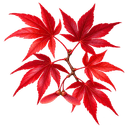
Japanese Maple
Acer palmatum
The Japanese maple is a small deciduous tree or large shrub from Japan, Korea and China, grown for its palmately lobed leaves and brilliant autumn colour. It is highly variable, with thousands of cultivars ranging from dwarf mounding forms to small trees.
Overview
Seasons
Planting time for bare-root trees. Container trees can be planted whenever the soil is workable.
Companion Planting
Good Companions
None
Bad Companions
- Tomato
Tomato is a host of the soil-borne fungus Verticillium dahliae, which also causes Verticillium wilt in maples; extension advice is to avoid planting maples on ground previously used for tomato or potato.
- Potato
Potato is a host of Verticillium dahliae, which persists in soil and infects maples; avoid planting maples where potatoes were grown.
- Eggplant
Eggplant is a listed vegetable host of Verticillium dahliae, the cause of Verticillium wilt in maples (shared soil-borne pathogen).
 Tomato
 Potato
 Eggplant
Only relations with a documented cause are listed.
Planting Tips
Care Tip: Prune only from July to January to avoid sap bleeding; mulch in late autumn to late winter keeping mulch off the trunk, and protect young leaves from late frost with fleece.
Sources
- Acer palmatum (Japanese Maple) — NC State Extension Gardener Plant Toolbox
- Acer palmatum – TreeEbb datasheet — Boomkwekerij Ebben (tree nursery, NL)
- Acer palmatum 'Ôsakazuki' – TreeEbb datasheet — Boomkwekerij Ebben (tree nursery, NL)
- How to grow Japanese maples – growing guide — Royal Horticultural Society
- Verticillium Wilt (Plants) – Pest Notes — University of California Statewide IPM Program
- Maple (Acer spp.) – Verticillium wilt — Pacific Northwest Plant Disease Management Handbook (OSU/WSU/UI Extension)
- How to grow trees – growing guide — Royal Horticultural Society