
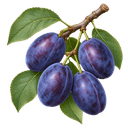
Plum
Prunus domestica
European plum (Prunus domestica), including the oval, freestone Zwetschge, is a medium-sized deciduous fruit tree that flowers white in spring before or with leaf-out and ripens blue, red or yellow stone fruit from July to September. Most cultivars are self-fertile; Sharka (plum pox virus) is the most important disease.
Overview
Seasons
Planting time for bare-root trees. Container trees can be planted whenever the soil is workable.
Grafted forms
| Form | Height | Crown diameter |
|---|---|---|
| Spindle bush | 3–4 m | 2.5–3 m |
| Bush tree | 4–5 m | 3.5–4 m |
| Half-standard | 4–5 m | 3–7 m |
| Standard | 6–6 m | 6–8 m |
Typical sizes; the rootstock, variety and pruning decide the actual size.
Companion Planting
Good Companions
None
Bad Companions
None
Shared disease: sharka (plum pox)
Other hosts in the database: Peach, Apricot. An infected tree can pass the disease on to them.
Only relations with a documented cause are listed.
Toxicity
Stems, leaves and seed kernels contain cyanogenic glycosides that release cyanide; wilting leaves are particularly dangerous to animals. The fruit flesh is edible.
Planting Tips
Care Tip: Prune young trees in early spring after bud break and established trees in summer; avoid dormant-season and autumn pruning (silver leaf, bacterial canker). Thin fruit on overloaded trees. Prefer Sharka-tolerant cultivars ('Katinka', 'Hanita') or hypersensitive ones ('Jojo'). Many plum cultivars are self-fertile, but self-sterile or partly self-fertile cultivars need a compatible plum flowering at the same time as pollinator.
Sources
- Prunus domestica (Common Plum) — NC State Extension, Extension Gardener Plant Toolbox
- European plum - Prunus domestica — University of Minnesota, Trees of Minnesota
- How to grow plums — Royal Horticultural Society (RHS)
- Obstbäume richtig pflanzen — Bundesinformationszentrum Landwirtschaft (BZL), landwirtschaft.de
- Empfehlungen für optimale Pflanzabstände im Obstbau (J. Maurer) — Inforama, Fachstelle für Obst und Beeren, Kanton Bern
- Das Schneiden der Obstbäume (Pflanzabstände, Kronenformen) — Landratsamt Enzkreis, Landwirtschaftsamt, Obst- und Gartenbauberatung
- Merkblatt 3160: Empfehlenswerte Steinobst-Sorten — Bayerische Landesanstalt für Weinbau und Gartenbau (LWG), Bayerische Gartenakademie
- Merkblatt 3160/b: Empfehlenswerte Steinobst-Sorten für den Haus- und Kleingarten (2017) — Bayerische Landesanstalt für Weinbau und Gartenbau (LWG), Bayerische Gartenakademie
- Home Garden Plums (Bulletin 1518) — University of Georgia Cooperative Extension
- Globale Erwärmung - bringt sie ein höheres Risiko für Spätfrostschäden? (Pressemitteilung 12.04.2023) — Deutscher Wetterdienst (DWD), via DLR Rheinland-Pfalz
- Plum (Prunus domestica) — ASPCA Animal Poison Control
- Scharka (Plum pox virus) — AGES - Österreichische Agentur für Gesundheit und Ernährungssicherheit