
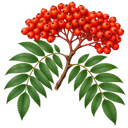
Rowan
Sorbus aucuparia
Rowan is a small native European tree of the rose family with pinnate leaves, flat clusters of white flowers in May–June and orange-red berries from August that are eaten by numerous bird species. Its light, feathery canopy casts only light shade, so shrubs and perennials can be underplanted.
Overview
Seasons
Planting time for bare-root trees. Container trees can be planted whenever the soil is workable.
Companion Planting
Good Companions
None
Bad Companions
None
Shared disease: fire blight
Other hosts in the database: Apple, Pear, Quince, Serviceberry, Crabapple. An infected tree can pass the disease on to them.
Only relations with a documented cause are listed.
Toxicity
Raw fresh berries contain about 0.4% parasorbic acid, which is strongly laxative; cooking converts it, and the RHS rates the plant 'potentially harmful' (fruit not to be eaten raw). No ASPCA entry for dogs/cats was found.
Planting Tips
Care Tip: Needs very little pruning; hard cutting produces suckers at the root collar and large wounds heal poorly. Can be affected by fire blight, rowan moth and gall mites.
Sources
- GALK-Straßenbaumliste (PDF export, queried 12.10.2026) — Deutsche Gartenamtsleiterkonferenz (GALK), Arbeitskreis Stadtbäume
- Van den Berk tree sheet: Sorbus aucuparia — Boomkwekerij Gebr. Van den Berk B.V. (tree nursery)
- Sorbus aucuparia (rowan) plant profile — Royal Horticultural Society (RHS)
- Die Vogelbeere (Sorbus aucuparia) – ein Porträt des Baum des Jahres 1997 (R. Erlbeck, LWF Wissen 17) — Bayerische Landesanstalt für Wald und Forstwirtschaft (hosted by LfL Bayern)
- Die Vogelbeere in der Gartengestaltung (W. Graf, LWF Wissen 17) — Bayerische Landesanstalt für Wald und Forstwirtschaft (hosted by LWG Bayern)
- NC State Extension Plant Toolbox: Sorbus aucuparia — North Carolina State University Extension
- Pflanzengesundheitliches Datenblatt Erwinia amylovora (ERWIAM 3/2022) — Julius Kühn-Institut (JKI)
- EPPO Datasheet: Erwinia amylovora (last updated 2020-04-22) — European and Mediterranean Plant Protection Organization (EPPO)
- Fireblight — Royal Horticultural Society (RHS)
- How to grow quinces — Royal Horticultural Society (RHS)
- Fire Blight – Fact Sheet 2.907 — Colorado State University Extension