
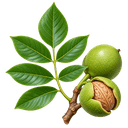
Walnut
Juglans regia
The common or Persian walnut is a large deciduous nut tree from south-eastern Europe and Central Asia with a broad, rounded crown and pinnate, aromatic leaves. Its nuts ripen in a green husk that splits open in late September and October.
Overview
Seasons
Planting time for bare-root trees. Container trees can be planted whenever the soil is workable.
Companion Planting
Good Companions
None
Bad Companions
- Tomato
Juglans regia forms the juglone precursor in all green parts; leaf litter releases juglone, which inhibits germination and growth of many plants. J. regia produces less juglone than black walnut, and allelopathy is described as weaker than often claimed; listed as sensitive by NC State Extension for J. regia. In vitro, J. regia leaf extract inhibited tomato only at high concentrations.
- Potato
Juglans regia forms the juglone precursor in all green parts; leaf litter releases juglone, which inhibits germination and growth of many plants. J. regia produces less juglone than black walnut, and allelopathy is described as weaker than often claimed; listed as sensitive by NC State Extension for J. regia.
- Bell Pepper
Juglans regia forms the juglone precursor in all green parts; leaf litter releases juglone, which inhibits germination and growth of many plants. J. regia produces less juglone than black walnut, and allelopathy is described as weaker than often claimed; listed as sensitive by NC State Extension for J. regia.
- Chili Pepper
Juglans regia forms the juglone precursor in all green parts; leaf litter releases juglone, which inhibits germination and growth of many plants. J. regia produces less juglone than black walnut, and allelopathy is described as weaker than often claimed; listed as sensitive by NC State Extension for J. regia.
- Blueberry
Juglans regia forms the juglone precursor in all green parts; leaf litter releases juglone, which inhibits germination and growth of many plants. J. regia produces less juglone than black walnut, and allelopathy is described as weaker than often claimed; listed as sensitive by NC State Extension for J. regia.
- Lettuce
In a laboratory study, aqueous J. regia leaf extract inhibited lettuce germination at all tested concentrations (juglone-type allelopathy).
 Tomato
 Potato
 Bell Pepper
 Chili Pepper
 Blueberry
 Lettuce
Only relations with a documented cause are listed.
Toxicity
The nuts are edible for humans. Mouldy walnuts (e.g. fallen nuts left on the ground) can contain tremorgenic Penicillium mycotoxins such as penitrem A, causing vomiting, tremors and seizures in dogs.
Planting Tips
Care Tip: Do not plant juglone-sensitive vegetables directly under the crown; collect fallen nuts promptly so dogs cannot eat mouldy ones.
Sources
- Baumartensteckbrief Walnuss (Juglans regia) — Nordwestdeutsche Forstliche Versuchsanstalt (NW-FVA)
- Juglans regia (Black Sea / English walnut) — NC State Extension Gardener Plant Toolbox
- TreeEbb: Juglans regia — Boomkwekerij Ebben (tree nursery, NL)
- Landscaping and Gardening Around Walnuts and Other Juglone Producing Plants — Penn State Extension
- A3182 Walnut and butternut toxicity — University of Wisconsin–Extension
- Walnut Toxicity (Juglone) — University of Maryland Extension
- Maksimović T., Hasanagić D. (2021): Allelopathic influence of Juglans regia L. aqueous extract on germination and growth of lettuce and tomato. J. Agric. Food Environ. Sci. 74(2) — Journal of Agricultural, Food and Environmental Sciences (Ss. Cyril and Methodius University, Skopje)
- Tremorgenic Neuromycotoxicosis in Dogs — Merck Veterinary Manual